Claimer: most of the content in this section i use boot.dev and skillbuilder.aws for recourses
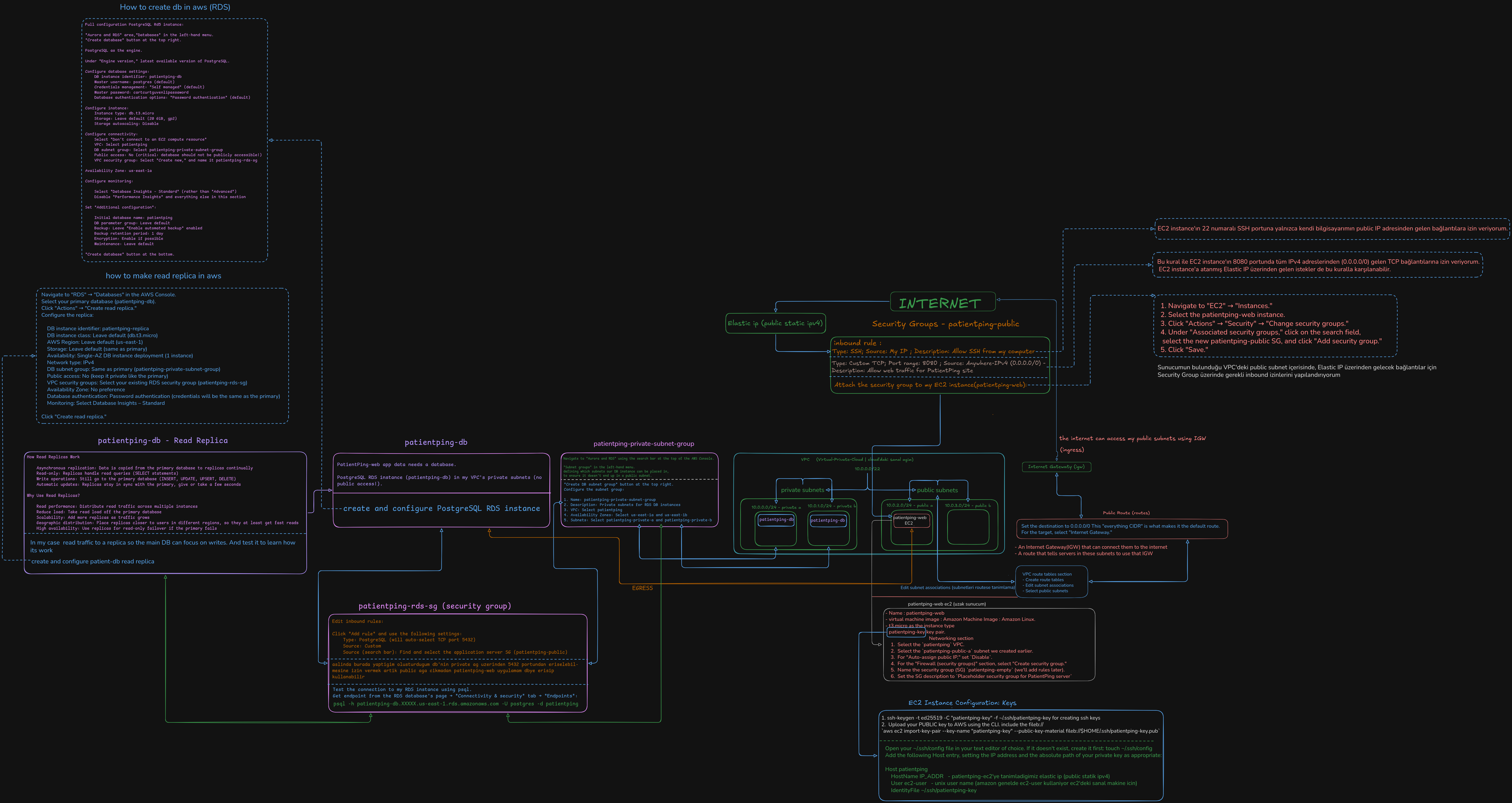
full diagram (without ecs i will update soon)
Here is the link to view the diagram I drew on Excalidraw: Diagram link(excalidraw)
Amazon Web Services is the cloud platform. Nearly every DevOps workflow runs on top of it in production. I use AWS to:
- Build isolated networks with VPCs, subnets, route tables and internet gateways
- Run virtual servers (EC2) with security groups, AMIs and launch templates
- Store data in managed databases (RDS) with backups and read replicas
- Control access with IAM users, groups, roles and policies
- Store files in S3 and serve them worldwide with CloudFront
- Route traffic with Route 53 DNS records
- Run containers with ECS or Kubernetes with EKS, serverless functions with Lambda
- Monitor everything with CloudWatch and CloudTrail
- And much more
Başlamadan önce:
AWS konular#
Networking - VPC’s#
- regions-and-availability-zones
- virtual-private-cloud-vpc
- aws-subnetting
- internet-gateways-igw
- route-tables
- private-subnets
- connecting-to-the-aws-cloud
EC2 (Elastic Compute Cloud)#
- ec2-instance-configuration-keys
- ec2-instances
- elastic-ips
- aws-security-groups
- ssh-to-aws-server
- deploy-site-to-aws-server
- open-web-traffic
- creating-and-using-your-own-ami
- aws-launch-template
- launch-from-template-aws
RDS: Relational Database Service#
- relational-database-service
- create-a-postgresql-database-in-aws
- aws-connect-to-your-database
- aws-connect-app-to-database
- rds-backups
- create-read-replicas-for-scalability
- rds-general-knowledge
Identity and Access Management (IAM)#
- create-iam-user-and-group
- identity-and-access-management
- create-iam-user
- inline-policies-iam-user
- iam-groups
- iam-roles
- aws-iam-deny-policies
- aws-ssm-parameter-store
- accessing-ssm-parameters-from-ec2
- use-ssm-from-ec2
Monitoring - AWS#
Amazon S3 - Simple Storage Service#
AWS - DNS - Route 53#
AWS - CDN - CloudFront#
- cloudfront-cdn
- cloudfront-distributions
- cloudfront-invalidation
- presigned-urls
- why-use-presigned-urls
- cloudfront-with-dns
AWS - ECS - Elastic Container Service#
- vpc-and-networking-setup-for-ecs
- why-ecs
- elastic-container-registry
- ecr-repo
- ecs-clusters
- ecs-permissions
- ecs-task-definitions
- ecs-security-groups
- application-load-balancer
- ecs-target-groups
- cloudwatch-log-groups
- ecs-services
AWS - EKS - Elastic Kubernetes Service#
- eks-cluster
- eks-vs-kubeadm
- eks-deploy-app
- eks-connect-s3
- eks-use-rds
- eks-node-affinity-taints
- eks-ha-cluster
- eks-spot-instances
AWS Lambda#
- aws-lambda
- deploy-lambda
- testing-lambda-function
- lambda-api-gateway
- cloudwatch-log-groups-and-viewing-lambda-logs
- other-lambda-use-cases